No Longer Does Search Happen In Just One Place.
People often switch between standard search results, Google’s AI Overviews, and AI answer solutions such as ChatGPT, Perplexity, and voice assistants in the same decision-making process.
In many cases, they now get an answer before even visiting a website. That means opinions are formed earlier, with less information, and using summaries rather than complete pages.
This shift changes how we can see things.
Instead of competing purely on rankings, marketers must now examine whether they appear within the answer itself.
That’s where Generative Engine Optimisation (GEO) comes in. GEO isn’t about getting higher search results.
It is important to ensure that your knowledge, explanations, and positioning are appropriately reflected in AI-generated responses, so that when questions are posed, your brand is included.
What Is GEO?
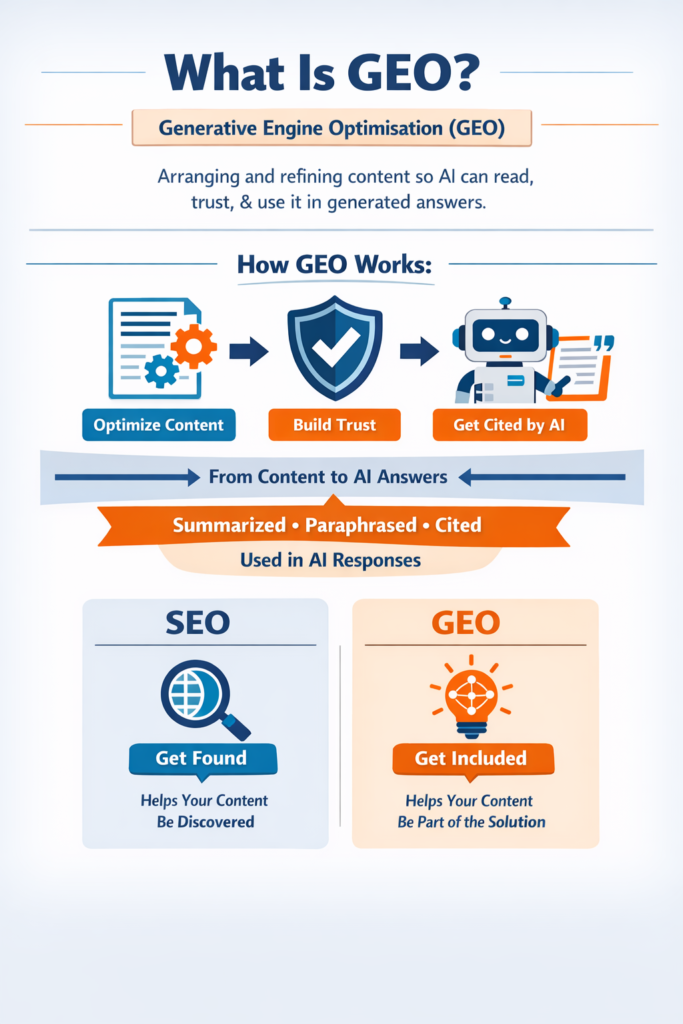
Generative Engine Optimisation (GEO) is the process of arranging and refining content so that AI systems can correctly read it, judge its trustworthiness, and include it into generated answers.
Rather than simply being searched or scraped, GEO-focused information is intended to be used summarized, paraphrased, and cited when AI systems respond to user queries.
Simply put:
SEO helps your content be discovered.
GEO helps your content become part of the solution.
A Simple Example
Let’s say someone asks:
“What is GEO in digital marketing?”
An AI system will not return a list of links. Instead, it will construct a brief explanation based on sources that it deems clear, credible, and relevant.
If your content is:
- Clearly written
- Well structured
- Factually sound
- Neutral in tone
- Easy to interpret
Your explanation is considerably more likely to serve as the foundation for that answer.
That is GEO in action: assembling your content such that it is part of the solution rather than just a result.
GEO vs Traditional SEO
Although GEO and traditional SEO are closely related, their functions are different.
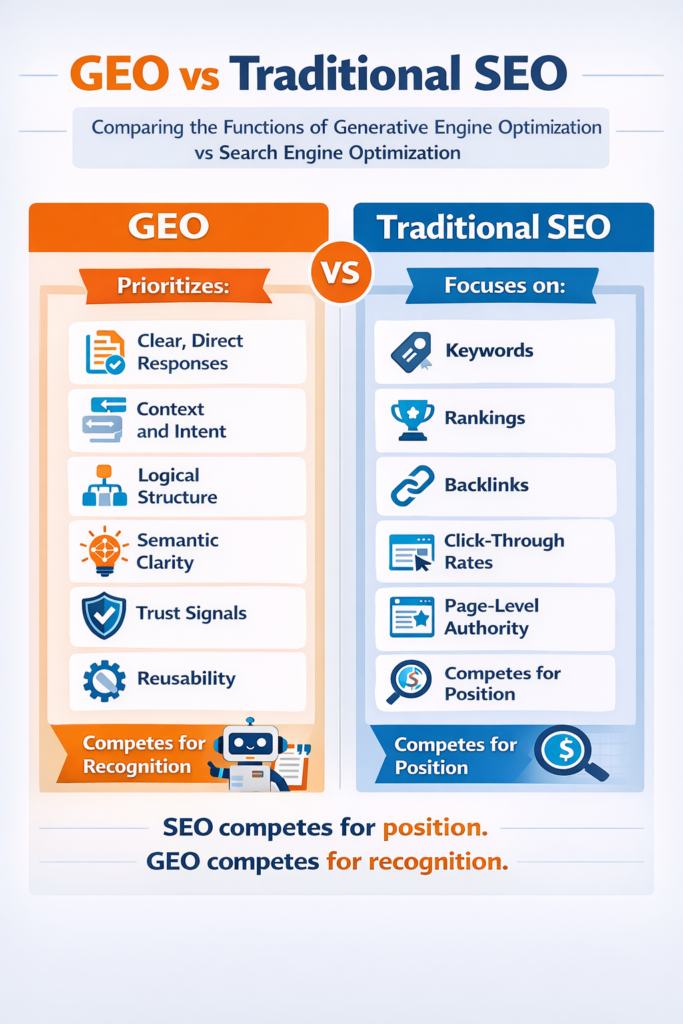
Traditional SEO is largely focused with increasing visibility in search results. It focuses on:
- Keywords
- Rankings
- Backlinks
- Click-through rates
- Page-level authority
On the other hand, GEO deals with how AI systems intake content. It prioritises:
- Clear, direct responses
- Context and Intent
- Logical structure
- Semantic clarity
- Trust signals
- Reusability
Simply said, SEO competes for position. GEO competes for recognition.
Why GEO Matters Now
Artificial intelligence-powered tools are quickly becoming the first point of search.
Instead of starting with traditional results pages, visitors now use platforms like ChatGPT, Google’s AI Overviews, Perplexity, and voice assistants to receive quick answers.
These systems do not explore the web in the same manner that humans do. They analyse information by scanning several sources, comparing perspectives, summarising key points, deciding which looks to be the most reliable, and then responding.
If your content is not arranged in a way that makes it simple to interpret and summarise, it is unlikely to be used at all.
What Does a GEO-Friendly Page Look Like?
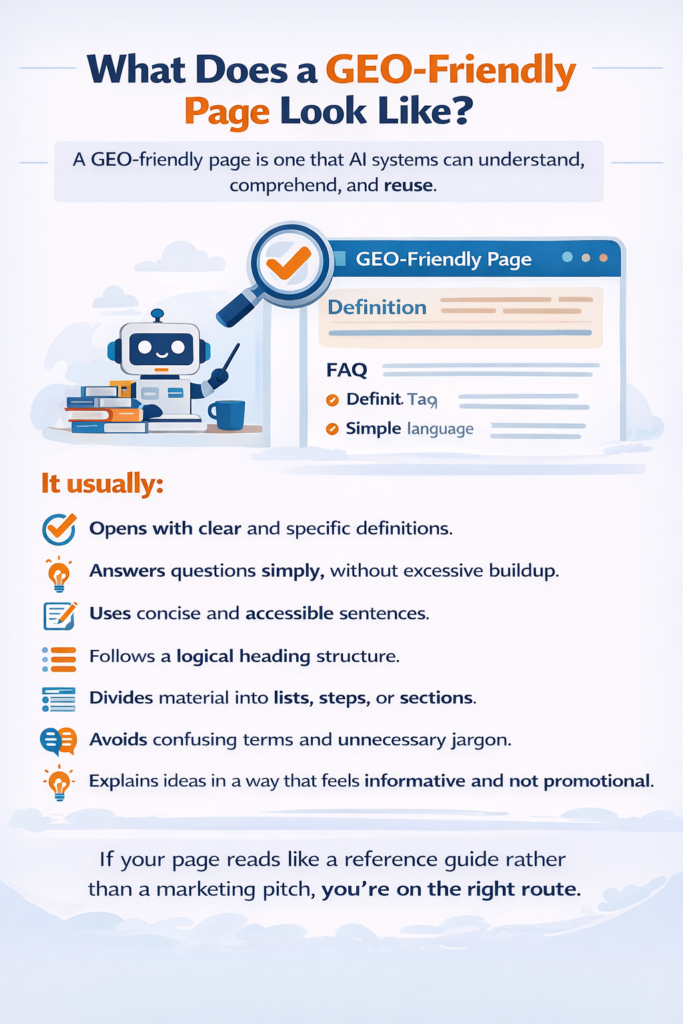
A GEO-friendly page is one that AI systems can understand, comprehend, and reuse.
It usually:
- Opens with clear and specific definitions.
- Answers questions simply, without excessive buildup.
- Use concise and accessible sentences.
- Follows a logical heading structure.
- Divides material into lists, steps, or sections.
- Avoids confusing terms and unnecessary jargon.
- Explains ideas in a way that feels informative and not promotional.
If your page reads like a reference guide rather than a marketing pitch, you’re on the right route.
GEO Strategy: How to Think About It
GEO calls for a change in the way you view content.
Instead of asking, “How do I rank for this?” a better question is, “Would an AI system trust this enough to reuse it?”
A successful GEO strategy chooses content that is:
- Easy to comprehend.
- Simple to sum up.
- Logically organised.
- Consistent with its messaging.
- Neutral, accurate, and informative.
The goal is not to impress algorithms through tactics. Its purpose is to establish the content you provide as a trustworthy source of explanation.
The Role of AI and Voice Search
AI and voice search have completely changed the way people search for information.
Instead of entering short, disconnected keywords, users now ask lengthy, conversational questions, much like they are talking to another person.
These often sound like:
- What is…
- How does…
- Why does…
- Should I…
- What’s the difference between…
Because of this change, GEO-focused text must read like a clear spoken explanation rather than a page designed to meet algorithms. It should feel natural, human, and easy to read more like to a conversation than a standard blog post.
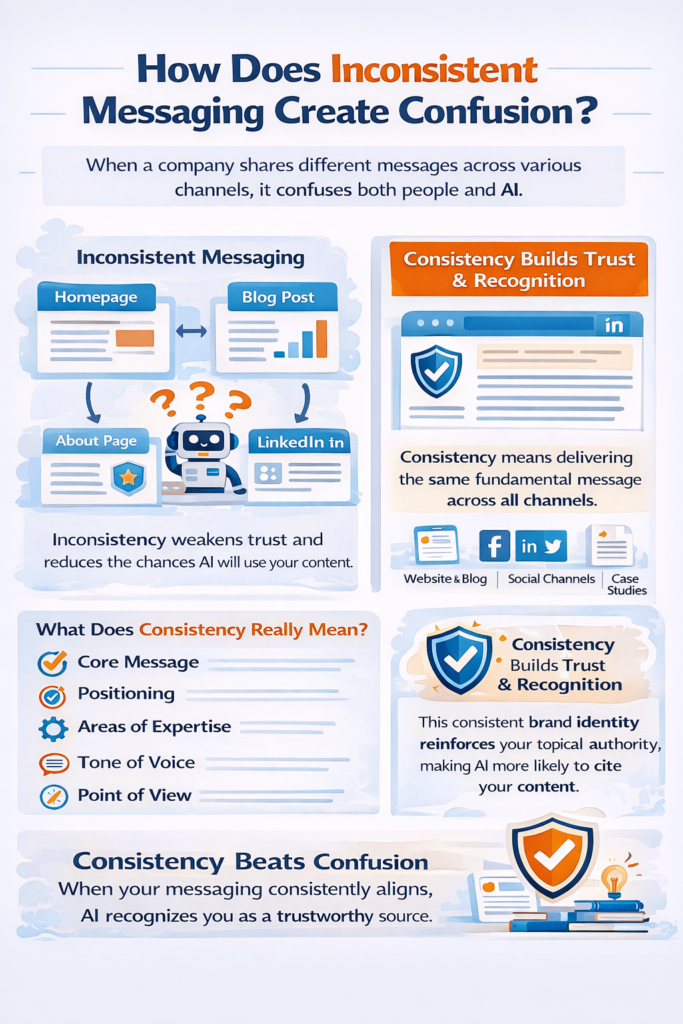
How Does Inconsistent Messaging Create Confusion?
When a company shares messages that clash across many channels, it generates confusion for both humans and AI systems.
For example:
- Your homepage could explain the service you provide in one way.
- Your blog post may frame it differently.
- Your About page may tell a different story.
- Your LinkedIn positioning may present yet another aspect.
While human readers frequently figure out meaning and context, AI systems rely on consistency to build trust.
When discrepancies surface, trust weakens. When confidence fades, AI is considerably less likely to use your content as a source.
What Does Consistency Actually Mean?
Consistency does not mean using the same terms everywhere.
It implies maintaining consistency throughout your content in terms of:
- Core message
- Positioning
- Areas of expertise
- Tone of Voice
- Point of View
This alignment should be obvious at all touchpoints, including your
- Website Blog
- Social Channels
- Case Studies
- Thought Leadership Content
When AI systems see these repeated patterns, they start to identify your brand with a consistent, recognised identity. Consistency builds confidence, which is an important factor for deciding whether your information is trusted and reused.
Why Does Consistency Strengthen GEO?
Artificial intelligence systems learn by spotting patterns.
- When your brand is consistent:
- Explains concepts in a similar manner.
- Uses recognised frameworks.
- Responds to similar queries.
- Demonstrates depth of knowledge.
AI begins to link your name with that topic content.
Over time, this relationship develops into what is known as topical authority, the notion that your brand is a trustworthy source on a certain topic.
And in the context of GEO, topical authority affects whether your information is just indexed or actively mentioned.
Give AI a Reason to Reference Your Site
AI systems do not select content at random. They prefer sources that are credible, straightforward, and useful.
In practice, this means people like content that:
- Uses a neutral, informative tone instead of a promotional one.
- Explains things clearly and without confusion.
- Avoids hyperbole and unjustified statements.
- Uses clear, understandable language.
- Follows a logical, simple framework.
- Feels truly educational.
In other words, your page should read like this.
A guide is not a pitch. This is a reference, not an advertisement.
When your content meets these standards, it becomes easier for AI systems to trust and is far more likely to be reused.
How to Bake GEO Into Your Marketing
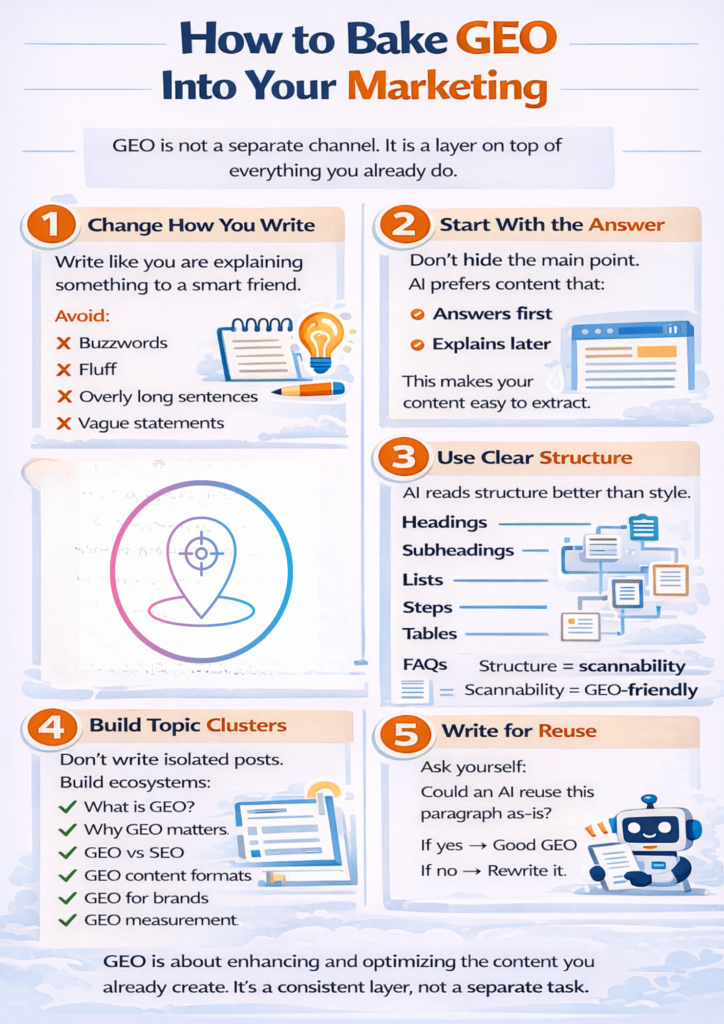
GEO is not a separate channel. It is a layer on top of everything you already do.
1. Change How You Write
Write like you are explaining something to a smart friend.
Avoid:
- Buzzwords
- Fluff
- Overly long sentences
- Vague statements
Use:
- Simple words
- Clear structure
- Short explanations
- Direct answers
2. Start With the Answer
Don’t hide the main point.
AI prefers content that:
- Answers first
- Explains later
This makes your content easy to extract.
3. Use Clear Structure
AI reads structure better than style.
Use:
- Headings
- Subheadings
- Lists
- Steps
- Tables
- FAQs
Structure = scannability
Scannability = GEO-friendly
4. Build Topic Clusters
Don’t write isolated posts.
Build ecosystems:
- What is GEO?
- Why GEO matters
- GEO vs SEO
- GEO content formats
- GEO for brands
- GEO measurement
Depth increases trust.
5. Write for Reuse
Ask yourself:
Could an AI reuse this paragraph as-is?
If yes → Good GEO
If no → Rewrite it
GEO Is Not About Gaming AI
GEO is not about manipulating or “hacking” AI systems. It is about making your content genuinely easier for them to understand and use.
AI models prioritise information that demonstrates:
- Clarity
- Accuracy
- Logical structure
- Neutrality
- Coherent reasoning
When your content aligns with these principles, it becomes easier for AI to interpret, summarise, and reference. And in return, that clarity is rewarded with visibility.
How GEO Changes Content Strategy
Traditional content strategies have largely focused on performance metrics: ranking keywords, driving clicks, and moving users through predefined funnels.
A GEO-driven strategy shifts that focus.
Instead of optimising solely for traffic, the goal becomes to:
- Establish your brand as a source
- Become a reliable reference
- Provide clear explanations
- Shape understanding, even without a click
In this model, influence does not depend entirely on visits. It depends on whether your ideas are trusted enough to be repeated, summarised, and shared by AI systems.
GEO and Brand Authority
In the AI era, authorities were no longer built through advertising alone.
It is built through consistency by being:
- Reliably useful
- Consistently clear
- Repeatedly accurate
When AI systems choose to reference your content, they signal to users that your brand is credible and knowledgeable.
In effect, every AI citation becomes a form of endorsement. And that, over time, is how brand equity is formed.
GEO Is a Long-Term Play
GEO is not something that produces immediate results.
It compounds over time.
The more you:
- Publish thoughtfully
- Clarify your ideas
- Structure your content
- Connect related topics
the more confidence AI systems develop in your expertise.
Trust, in this context, is cumulative. It is built through repetition, coherence, and depth, not quick wins.
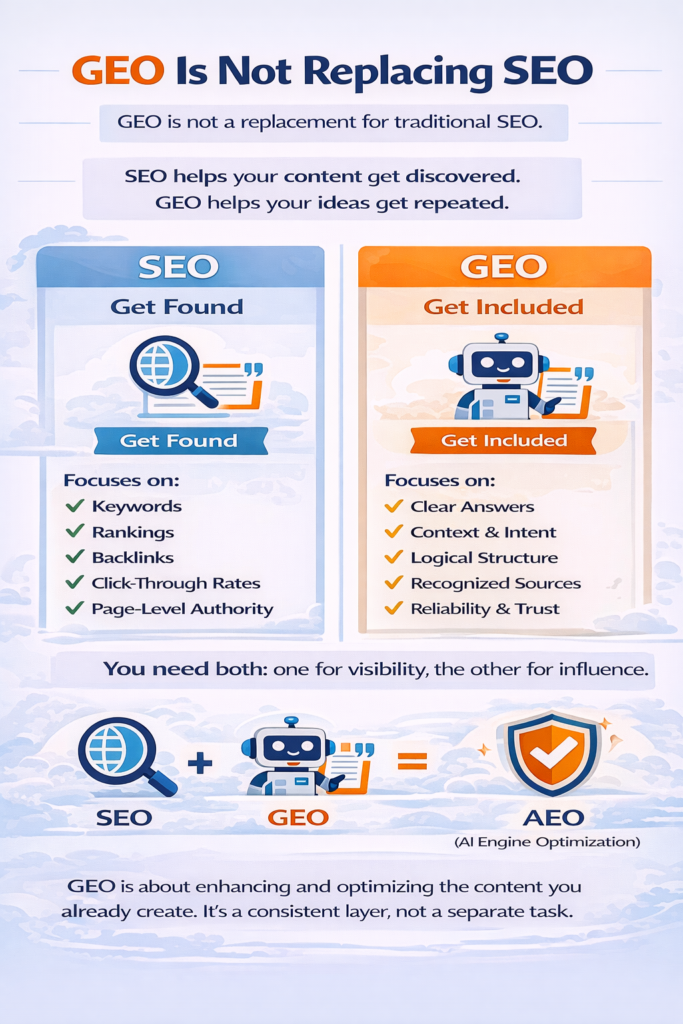
GEO Is Not Replacing SEO
GEO is not a replacement for traditional SEO.
SEO helps your content get discovered. GEO helps your ideas get repeated.
You need both: one for visibility, the other for influence.
Final Thought
In the AI era, visibility is no longer defined by where you rank. It is defined by whether your ideas become part of the answer.
Generative Engine Optimisation is what makes that possible. It shifts your focus from chasing placement to building credibility, clarity, and trust, so your expertise is not just discovered but reused.
This is the direction we’re building towards at Online Presence: helping brands structure their content for both human understanding and AI interpretation, so they remain visible even as search continues to evolve. Because in a world where answers are generated, the real advantage is being the source.